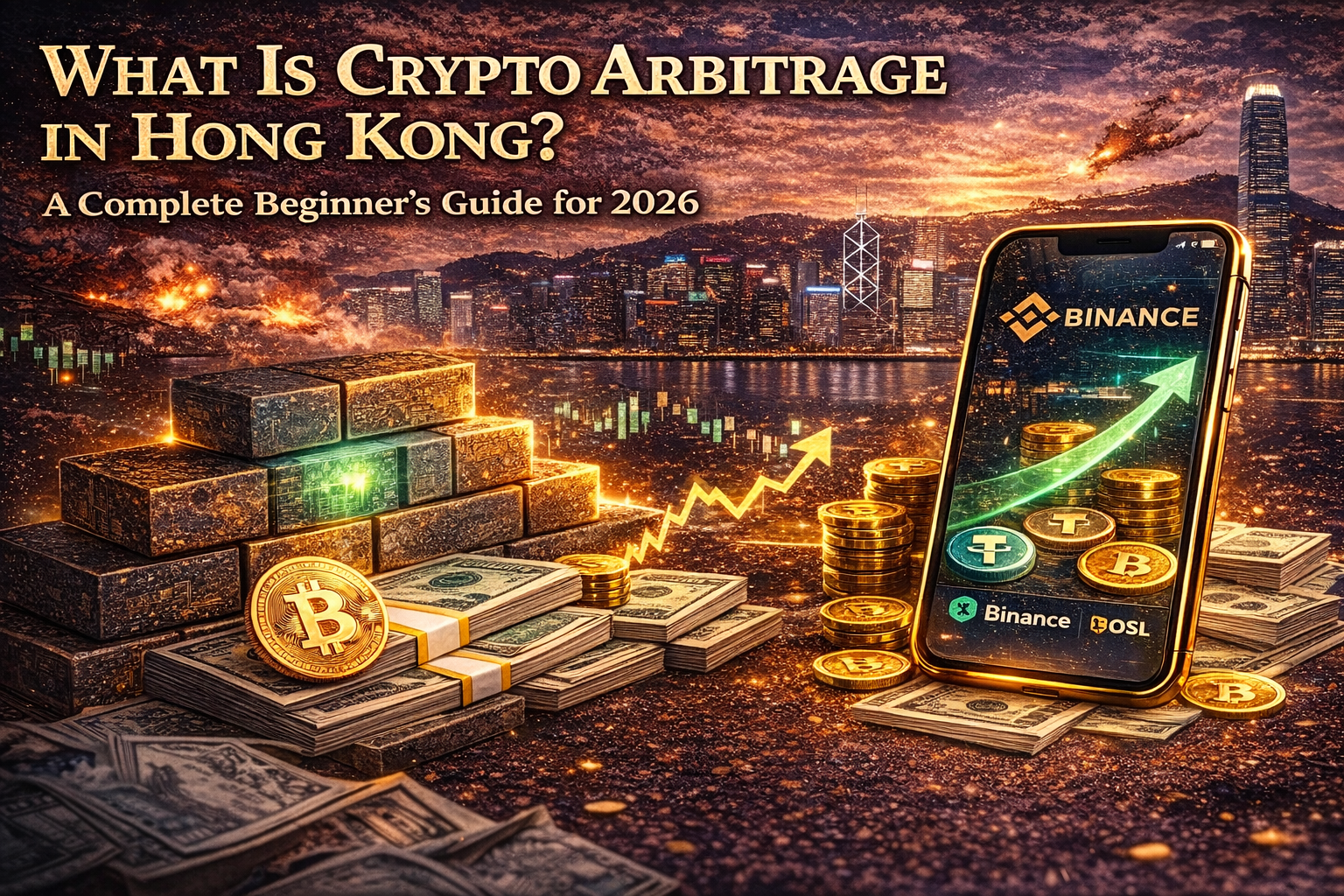
What Is Crypto Arbitrage in Hong Kong? A Complete Beginner's Guide for 2026
04月 17, 2026
What exactly is crypto arbitrage? This guide explains how arbitrage works in Hong Kong's crypto market — including profit logic, common types, step-by-step flow, and real risks every beginner must know before starting.
You've probably seen the term "arbitrage" thrown around in crypto communities. Maybe a friend mentioned it — said it's a way to earn consistent spreads without betting on price direction. But what actually is crypto arbitrage? Is it genuinely stable income, or just another high-risk strategy dressed up in safer-sounding language? This guide breaks it all down from scratch, in plain English.
The Core Idea: You're Earning the Gap, Not the Move
Arbitrage, at its simplest, means this: the same asset is priced differently in two different places. You buy where it's cheaper, sell where it's more expensive, and pocket the difference. This isn't a concept invented by crypto. Traditional financial markets have always had arbitrage — in forex, equities, and commodities. What makes crypto particularly well-suited for it:
Hundreds of exchanges operate globally with independent pricing mechanisms Market efficiency is still relatively low compared to traditional finance Stablecoins like USDT make cross-platform transfers fast and cheap Markets run 24/7, so opportunities appear at any hour
The key distinction: arbitrage profits come from pricing inconsistencies across markets, not from predicting whether a coin goes up or down. That's the fundamental difference from speculative trading.
Types of Crypto Arbitrage You Should Know
There are several common types. Here's what each one actually looks like:
1.Cross-Exchange Arbitrage The same coin — say BTC or USDT — is priced differently on two exchanges. You buy on Exchange A and immediately sell on Exchange B, capturing the spread after fees. This is the most straightforward form, but also the most competitive. Automated bots constantly monitor these gaps and close them within milliseconds. Manual execution rarely wins here. 2. Fiat Arbitrage / OTC Arbitrage This is the type most commonly discussed in Hong Kong's arbitrage community, and the most practical for beginners with sufficient capital. The logic: exploit the pricing gap between the fiat market and the crypto exchange rate. A simple example: suppose the OTC market in Hong Kong is quoting USDT at HKD 7.85, but based on the standard USD/HKD rate, USDT should be worth HKD 7.80. You source USDT at 7.80 and sell at 7.85 — earning HKD 0.05 per USDT. That sounds tiny. But move HKD 100,000 to 1,000,000 in a single round, and the numbers become meaningful fast.
-
Triangular Arbitrage This exploits pricing mismatches between three currency pairs. For example: BTC → ETH → USDT → BTC. If you end the cycle with more BTC than you started with, you've completed a successful triangular arbitrage. The math is more complex and usually requires algorithmic execution. Not recommended as a starting point for beginners.
-
Funding Rate Arbitrage In perpetual futures markets, long and short positions periodically pay each other a "funding rate." When the rate is positive, longs pay shorts; when negative, the reverse. The strategy: hold a spot position in a coin while simultaneously opening the opposite direction in futures — creating a market-neutral position — and collect the funding rate as passive income every few hours. This approach is especially popular in bull markets when funding rates consistently favor short positions.
What Does a Full Arbitrage Cycle Actually Look Like?
Using OTC USDT arbitrage as an example, here's a typical end-to-end flow:
Prepare capital — Have HKD or USD ready. A meaningful position size is required for the spread to cover all costs. Identify the opportunity — Monitor the gap between OTC market quotes and exchange spot prices. Execute the buy — Purchase USDT from the lower-priced source. Transfer on-chain — Move USDT via blockchain (TRC20/TRON is commonly used due to its low fees and fast confirmation). Execute the sell — Sell USDT at the higher-priced destination. Withdraw fiat — Convert back to HKD or USD and return funds to your bank account.
The full cycle can take anywhere from a few minutes to a few hours, depending on how long the pricing window stays open.
Is Arbitrage Really Risk-Free?
This is one of the most common misconceptions among beginners, and it needs to be addressed directly: arbitrage is not risk-free. Here are the most common risks you'll encounter: Execution Risk — The spread you see may disappear before you finish the trade. Markets move in seconds. Manual execution is often too slow to capture the window. Transfer Delay Risk — Blockchain confirmations take time. If the market moves during the 10–20 minutes while your on-chain transfer is pending, the spread may have narrowed or even reversed by the time you're ready to sell. Liquidity Risk — Especially in OTC markets, counterparties may not be able to absorb large volumes at your target price. Slippage on large orders can eat significantly into your margin. Compliance and Money Laundering Risk — This is a particularly serious concern in Hong Kong's OTC arbitrage scene. OTC transactions carry the risk of inadvertently receiving funds of unknown or illegal origin. If "dirty money" passes through your hands — even unknowingly — your accounts can be frozen and you may face legal liability. This is why Anti-Money Laundering (AML) knowledge is considered a non-negotiable foundation for anyone doing OTC arbitrage in Hong Kong. FX Volatility Risk — If your arbitrage involves fiat currency conversion, short-term movements in HKD or other currencies can affect your final returns.
Before You Start: What Every Beginner Should Prepare
If you're serious about understanding arbitrage, here are the practical steps to take before putting any real capital at risk:
Assess whether your capital size makes sense. Arbitrage margins are typically fractions of a percent per cycle. If your principal is too small, fees will wipe out any profit. In Hong Kong's OTC market, meaningful arbitrage generally starts from tens of thousands of HKD upward — larger capital is needed for compounding to work consistently. Learn on-chain transfers thoroughly. Arbitrage involves frequent blockchain transfers. Sending funds to the wrong network (e.g. confusing TRC20 with ERC20) can result in permanent loss. This is a technical skill you must learn yourself — it cannot be delegated. Use regulated platforms. In Hong Kong, prioritize exchanges licensed by the Securities and Futures Commission (SFC), such as HashKey Exchange and OSL. Regulated platforms offer clearer asset protection and more transparent withdrawal processes. Understand the basics of Hong Kong's AML framework. Any OTC transaction involving virtual assets should involve verifying the source of funds from your counterparty. Becoming — even unknowingly — a link in a money laundering chain carries serious legal consequences. Start with a small test run. Don't deploy large capital on your first attempt. Use a small amount to walk through the entire cycle — account setup, deposit, on-chain transfer, withdrawal — before scaling up.
Who Is Arbitrage Actually Suited For?
Arbitrage isn't for everyone. It tends to work best for people who:
Want to reduce dependence on coin price direction and prefer more consistent cash flow Are patient and willing to invest time in learning the technical and operational details Have sufficient capital for the spread to be meaningful after costs Can accept occasional execution errors or missed windows without overreacting
If you're expecting fast, explosive gains — arbitrage will likely disappoint. It's a strategy built on precision and process, not on speculation.
Risk Disclaimer
This article is for educational purposes only and does not constitute investment advice. Cryptocurrency trading involves significant risk. Arbitrage operations carry legal and compliance responsibilities. Please conduct thorough due diligence and consult qualified legal and financial professionals before making any decisions.
Summary
Arbitrage profits from pricing gaps across markets — not from predicting price direction. For beginners, the priority isn't to start immediately, but to first understand the mechanics, the operational flow, and how to manage risk properly. Hong Kong's crypto ecosystem is relatively mature, with a growing regulatory framework that creates a real structural advantage for arbitrage participants. But advantage is not the same as safety. The preparation you do before entering the market is always the most valuable investment you can make.